Concrete Floor Installation
New concrete slabs for garages, workshops, and utility spaces - properly graded and base-prepped for Ocala's sandy soil.
Learn more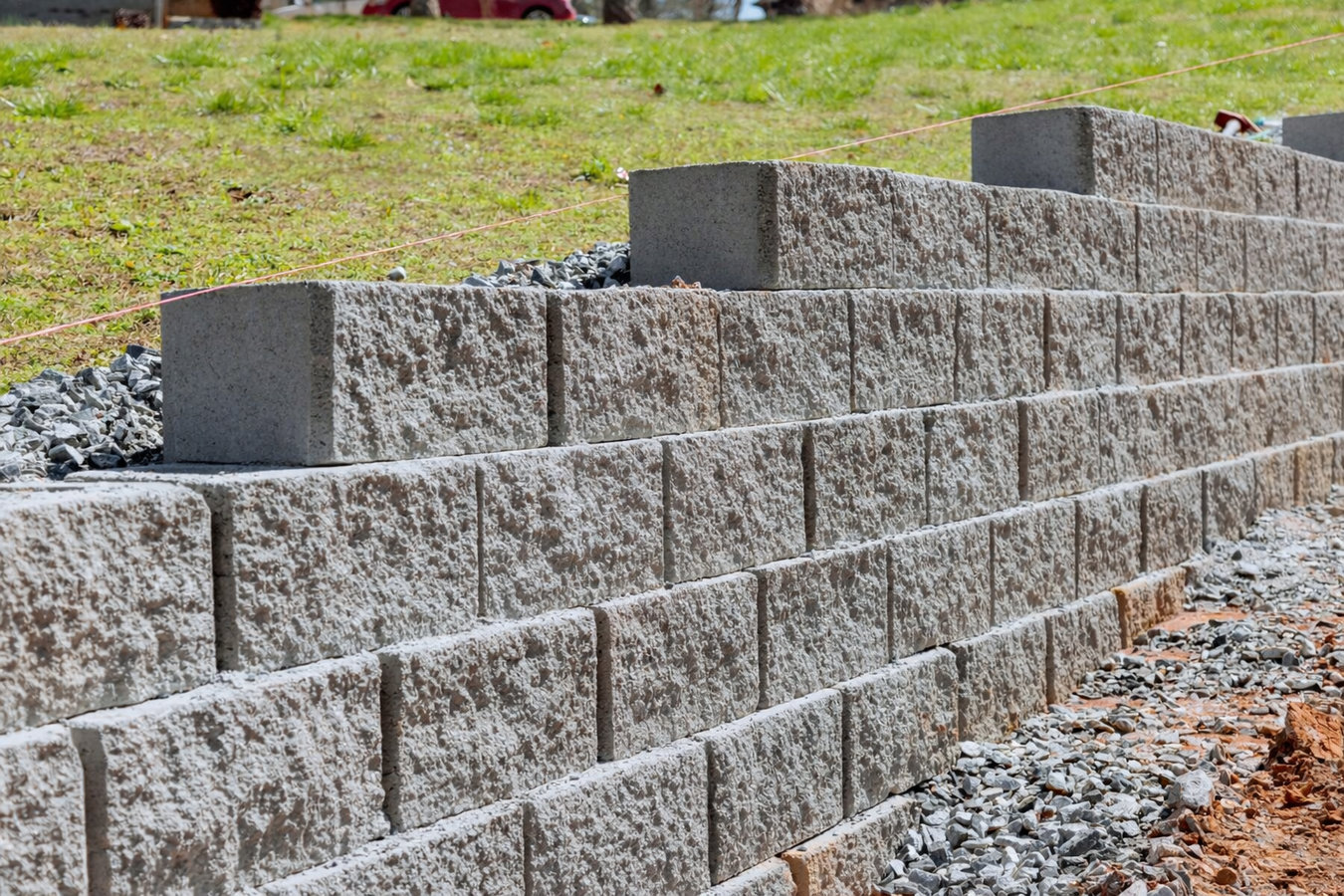
Ocala's sandy soil and heavy summer rain will keep washing your slope away until a proper wall - with drainage built in - gives it a permanent edge to hold against.
Concrete retaining walls in Ocala hold back soil on sloped or uneven ground, stopping erosion and creating usable flat space where there was none - most residential jobs run one to three days on-site, with the finished wall ready for landscaping within a week. Drainage behind the wall is the most critical part of any installation in this area, because saturated soil during Ocala's rainy season creates the pressure that eventually fails a wall without it.
If your yard has a slope that makes the space unusable or a hillside that washes toward your foundation every summer, a retaining wall solves both problems in a single project. The wall holds the grade; the drainage behind it handles the water. Without both working together, the wall will not last regardless of how good the concrete is.
Homeowners who are leveling outdoor areas sometimes also ask about concrete floor installation for garages or utility spaces on the same property - we can often coordinate both in a single project visit to save scheduling time.
If you see bare patches, ruts, or small channels carved into sloped areas of your yard after Ocala's summer downpours, the soil is actively eroding. Left alone, that movement works toward your foundation, driveway, or landscaping. A retaining wall stops it at the source by giving the slope a stable edge to hold against.
A yard too steep to mow safely or too uneven for outdoor furniture is dead space. This is common in Ocala neighborhoods built on rolling terrain, where original grading left awkward slopes between the house and the property line. A retaining wall creates a level terrace that becomes immediately usable.
A wall beginning to lean forward - even slightly - means the pressure behind it is winning. Horizontal cracks across the face are a serious warning sign. If you can see daylight between the base of the wall and the soil, or if sections have pulled apart, the wall needs professional attention before it fails completely.
When there is no wall redirecting water flow, heavy rain pushes water toward your home. In Ocala's rainy season this happens fast and repeatedly. A retaining wall combined with proper grading redirects that water away from your foundation and prevents the slow, invisible damage that shows up years later as cracks and settlement.
Every retaining wall project starts with a free on-site estimate. We look at the slope, the soil, what sits above and below the planned wall, and whether any underground utilities are nearby. Marion County requires permits for walls over four feet tall measured from the footing bottom - we handle that application for you. For taller walls, our process includes the engineer review the county requires before permit approval.
We build poured concrete walls and concrete block walls, depending on the site and homeowner preference. Poured concrete suits longer, continuous runs where a monolithic wall is structurally advantageous. Concrete block is practical for tighter spaces and walls where the finished appearance matters, since it can be surfaced or capped to match the surrounding landscape. Either way, gravel backfill and perforated drain pipe behind the wall are non-negotiable on every project we build.
For projects that involve stairs alongside the wall - connecting a lower yard to an upper terrace - see our concrete steps construction page. Many retaining wall projects in Ocala include steps as part of the same scope, and we plan both together so they sit and drain as a unified system.
Best for long, continuous runs where monolithic strength and a smooth face are priorities.
Suited to tighter sites and projects where the finished surface will be painted, stuccoed, or capped.
Multiple shorter walls stepping up a slope, ideal for steep grades that a single tall wall cannot handle safely.
Ocala sits on Marion County's sandy, karst-underlain soil - a loose, porous material that shifts and settles more than the clay-heavy soils found in other parts of the country. A footing set to generic depth specs will move in this ground. Every retaining wall we build here goes deeper than a standard guide would suggest, with compacted base material added specifically to offset the loose soil conditions local to this area.
Ocala averages 50 to 55 inches of rain per year, with the heaviest rainfall between June and September. During those months, soil behind a retaining wall can become saturated quickly, dramatically increasing the pressure pushing against it. This is why drainage behind the wall - gravel backfill and perforated pipe - is the single most important factor in how long a wall lasts in this climate. The Federal Highway Administration's retaining wall guidance covers exactly why drainage design matters for long-term wall stability.
We serve homeowners throughout the region, including Gainesville, Leesburg, and The Villages. Soil conditions and drainage requirements are similar across this part of North Central Florida, so our preparation standards apply consistently across every job we take in the area.
We visit your property to look at the slope, soil, and drainage conditions - and give you a written quote covering excavation, drainage, concrete, permit fees, and cleanup. We respond within 1 business day.
If your wall requires a Marion County permit, we submit the application on your behalf. Approval typically takes one to three weeks. We schedule your start date around that timeline and Ocala's rainy season.
The crew marks layout, digs the base trench, and calls for a utility locate before breaking ground. Wall construction and drainage installation happen in the same phase, usually taking one to two days for a typical residential wall.
We grade the soil behind the wall, haul debris, and coordinate the county inspection if one is required. Before leaving, we walk you through the finished wall and tell you what to watch for in the first rainy season.
We respond within 1 business day. There is no obligation - just a free on-site look and a written estimate before you decide anything. After you submit, someone from our office calls to schedule the visit at your convenience.
(813) 869-3491Our state license through the Florida Department of Business and Professional Regulation is verifiable online before you hire us. Every wall that requires a Marion County permit gets one - an inspector confirms the finished work meets local standards, not just our word.
We work in Ocala and the surrounding area full-time. We know the sandy karst soil here needs deeper footings and more compacted base material than most generic estimates account for - and we price that preparation into every job from the start.
Every retaining wall we build includes gravel backfill and perforated drain pipe behind the wall. This is not optional. The American Concrete Institute confirms that drainage design is the primary factor in long-term wall performance - and we treat it that way.
Our quotes spell out excavation, drainage, materials, permit fees, and cleanup before work begins. Ocala's soil conditions vary from one neighborhood to the next, so we visit every site in person before putting a number on paper - phone estimates are not something we offer for retaining walls.
A retaining wall built without proper drainage will fail in Ocala's rainy season, regardless of how solid the concrete looks on day one. Getting the drainage right - and setting the footing deep enough for sandy soil - is what separates a wall that lasts 50 years from one that starts leaning in five.
New concrete slabs for garages, workshops, and utility spaces - properly graded and base-prepped for Ocala's sandy soil.
Learn moreSteps built to connect terraced levels created by a retaining wall, designed to drain cleanly and hold up to Florida's UV and rain.
Learn moreRainy season arrives fast in Central Florida - get your wall designed, permitted, and built before the ground starts moving again this summer.